
Powering Your Safeguard Supply Receiver at Home or Abroad
Find the right power adapter for your Safeguard Supply ERA or LRA receiver, understand voltage requirements, and prepare for use outside the United States.
Published November 6, 2026
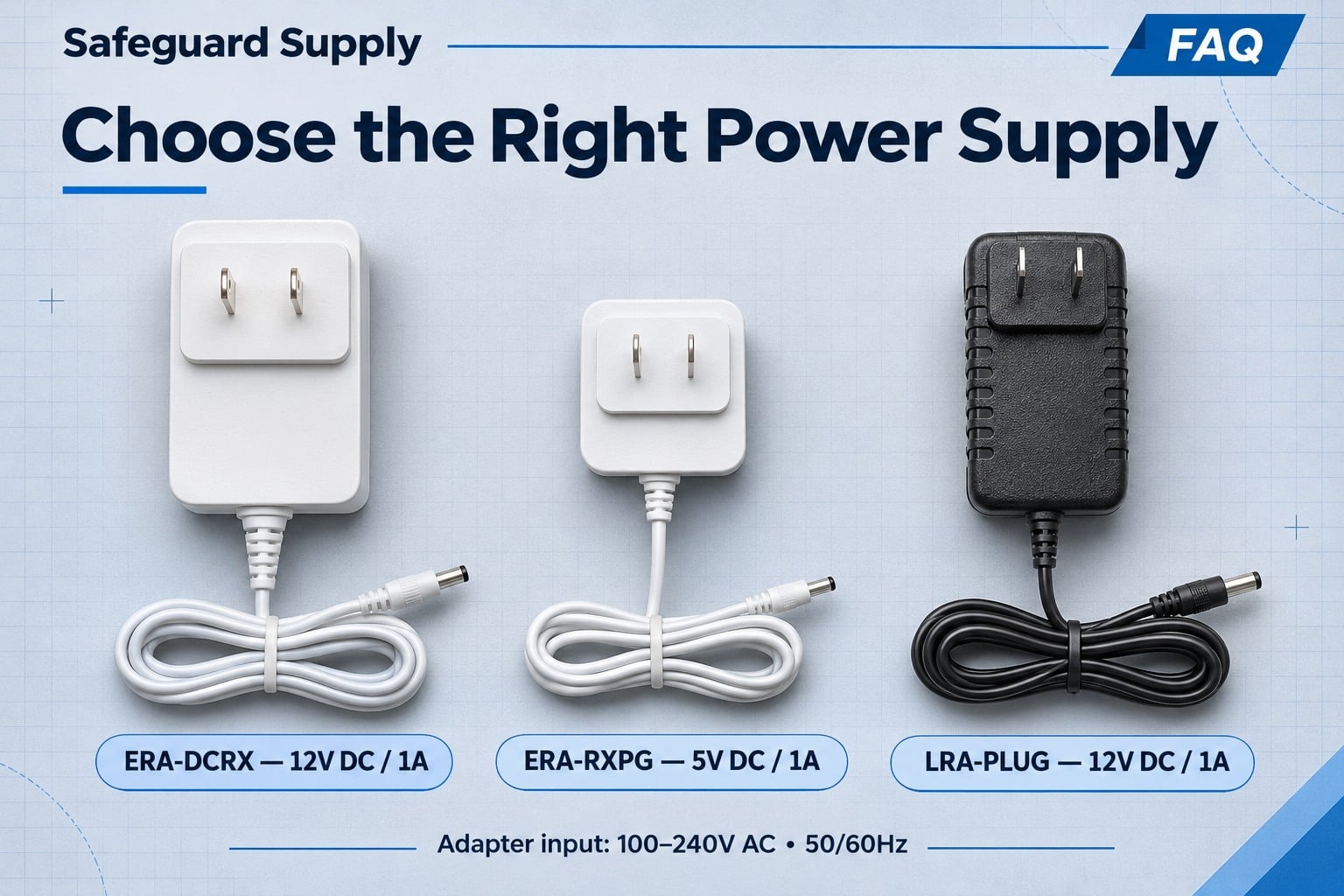
Before connecting a receiver, check two things: the power supply’s electrical rating and the shape of the wall plug. The documented LRA-PLUG, ERA-DCRX and ERA-RXPG power adapters accept 100–240V AC at 50/60Hz, but they do not all deliver the same DC voltage to the receiver.
Use the information below to identify the correct power supply and determine whether a travel plug adapter is needed. The label on the adapter supplied with your unit takes precedence, since hardware versions may differ.
Which Power Supply Does My Receiver Use?
ERA-DCRX Desktop Receiver
The documented ERA-DCRX AC/DC adapter accepts 100–240V AC, 50/60Hz, 0.4A and delivers 12V DC at 1.0A to the receiver.
ERA-RXPG Receiver
The documented ERA-RXPG supply accepts 100–240V AC, 50/60Hz, 0.3A. Its output is 5V DC at 1000mA, equivalent to 1.0A.
LRA-PLUG Receiver Adapter
The LRA-PLUG is a wall-power accessory for compatible LRA receivers, including the LRA-DCRX-L. Its input is 100–240V AC, 50/60Hz, and its output is 12V DC at 1.0A.
On compatible battery-powered receiver listings, the LRA-PLUG is an optional power source. Review the package contents before ordering, as it may be sold separately.
How Do I Find the Power Requirements for a Kit?
Look at the receiver model, rather than relying only on the kit name. The receiver determines which adapter belongs with the system:
- An ERA-DCRX receiver uses its corresponding 12V DC power supply.
- An ERA-RXPG receiver uses its corresponding 5V DC power supply.
- A compatible LRA-DCRX-L can use the optional 12V DC LRA-PLUG instead of relying only on batteries.
This guidance concerns power for the receiver. A wireless sensor or push button has its own power requirements. In a wired-doorbell extender installation, the existing doorbell transformer is also a separate component.
Other ERA and LRA receiver models, including portable units, require their own specifications. Do not assume the ratings above apply to the entire product family.
Will the Supplied Plug Fit My Wall Outlet?
The photographed power adapters use a two-flat-blade US Type A plug. This normally fits compatible household outlets in the United States and Canada without an additional plug adapter.
Outside those destinations, inspect the socket or check the country’s outlet standard. If the plug shape differs, choose a travel adapter that accepts the US plug and fits the destination socket securely.
- Continental Europe: A destination-compatible round-pin adapter is commonly needed. Socket arrangements vary, including in Switzerland and Italy.
- UK and Ireland: Choose a suitable Type G connection.
- Australia and New Zealand: Choose a suitable Type I connection.
- Japan: The US-style two-blade plug generally fits compatible Type A sockets; check the actual outlet.
Select an adapter rated for the local mains supply and intended for the country you are visiting.
Do I Need to Step European Voltage Down to 120V?
No, provided your power supply is labeled 100–240V AC, 50/60Hz and the local electricity falls within that range. A typical European 230V household supply is within the documented adapters’ input rating.
The receiver’s AC/DC supply performs the conversion to its required low-voltage DC output. A travel plug adapter only provides the mechanical fit between that supply and the wall socket.
For these multi-voltage adapters, the usual arrangement abroad is: local outlet → suitable plug adapter → original power supply → receiver.
Will a Change from 60Hz to 50Hz Affect the Power Adapter?
The documented adapters support both 50Hz and 60Hz. No frequency conversion is needed when the supply meets the label’s voltage and frequency ratings.
Why Must I Keep the 5V and 12V Supplies Separate?
The ERA-RXPG’s documented supply delivers 5V DC. The documented ERA-DCRX supply and LRA-PLUG deliver 12V DC. These are different output voltages, even though all three adapters are rated at 1.0A.
Never connect the 12V supply to the ERA-RXPG’s 5V power connection. An incorrect voltage can damage the receiver. Labeling adapters with their receiver model can help keep them paired correctly.
Does Matching Voltage Make Two Adapters Interchangeable?
No. Even when two adapters both say 12V DC, you must also confirm the connector dimensions, polarity and available current meet the receiver’s requirements.
For example, the LRA-PLUG and documented ERA-DCRX adapter share a 12V DC, 1.0A output rating. That does not, by itself, confirm that one is an approved replacement for the other.
What Does the Amperage on the Label Tell Me?
The output current rating describes how much current the adapter can supply. 1.0A and 1000mA mean the same thing. The receiver draws the current it needs during operation; a 1.0A rating does not mean one amp is continuously forced into it.
A replacement must provide sufficient current capacity, but a higher amperage rating alone does not prove suitability. The voltage, connector, polarity and receiver specifications must also be correct.
How Should I Choose a Replacement Power Supply?
Use a replacement approved for your exact receiver model. Before connecting it, verify:
- The required DC output voltage.
- Sufficient output current capacity.
- The correct connector size and shape.
- Matching connector polarity.
- An AC input rating suitable for the country of use.
If you cannot confirm any of these details, send customer support a photograph of the original adapter label and the receiver’s model number.
Where Can the Power Adapter Be Installed?
Keep the documented adapters indoors and dry; their labels indicate indoor use. An outdoor-rated transmitter or sensor does not make the receiver’s power supply suitable for outdoor exposure.
Does the Input Rating Confirm Worldwide Product Approval?
No. An adapter that accepts the local electricity is electrically compatible with that supply, but this does not establish permission to operate the wireless system in every country. Confirm destination suitability separately when using equipment outside its intended sales region.
What Details Help Support Identify the Right Setup?
Provide the receiver model, kit name if applicable, a readable picture of the power supply label and your destination country. Tell us whether you are replacing a missing adapter or adapting the original supply to a different outlet. This helps distinguish a replacement AC/DC power supply from a simple travel plug adapter.
Where to go next
When this article answers part of your question, use these links to choose a receiver, find your product family, or browse the full catalog.
Browse FAQ categories
Jump straight to the product family and topic you need.
Learn moreBrowse all documentation
Open the full manual and article library when you need adjacent guides, wiring notes, or compatibility references.
Learn morePreview receiver sounds
Compare tones, sirens, and strobe-linked alerts before choosing a receiver or system.
Learn moreReturn to the product catalog
Head back to the catalog once you know which family or alert type fits the job.
Learn moreGet expert help
Reach the Safeguard team when the next decision still needs a human recommendation.
Learn more